
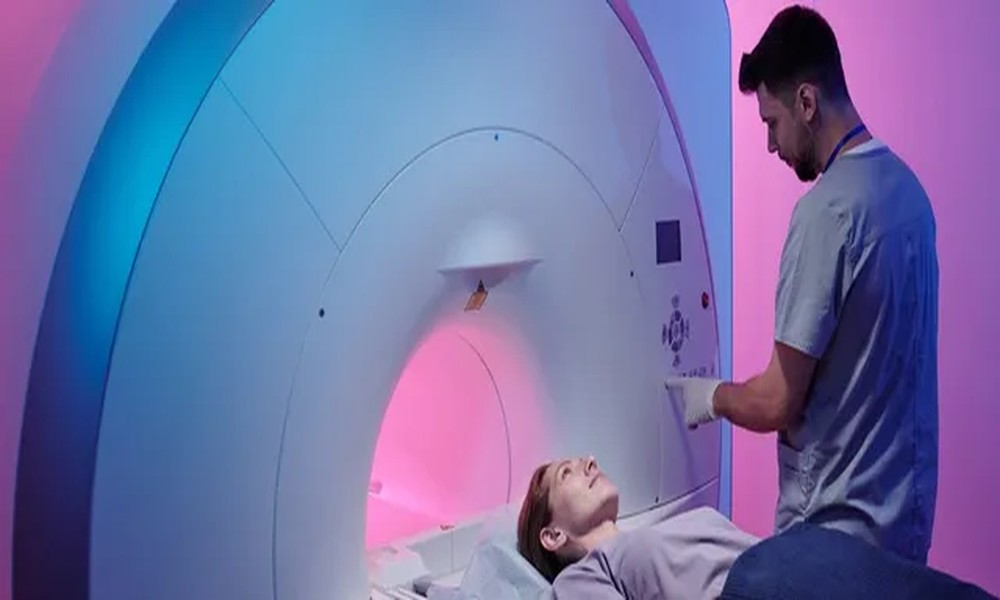
It is one of the more frustrating experiences in musculoskeletal medicine: a patient with significant, persistent pain undergoes an MRI, and the results come back showing only mild changes, or nothing that obviously explains the severity of what they are feeling. The patient is left wondering whether their pain is being taken seriously, while the imaging report and their lived experience seem to describe two different bodies.
In many cases, the explanation is not that the pain is exaggerated or unexplainable. It is that the position the patient was in during the scan does not reflect the position in which their symptoms actually occur. Understanding why position changes what an MRI shows helps explain this disconnect and points toward how it can be resolved.
Your Spine Is Not a Fixed Structure
It is easy to think of the spine as a rigid stack of bones that looks the same regardless of position, but this is not how it actually behaves. The spine is a dynamic structure made up of vertebrae, discs, ligaments, and muscles that respond continuously to gravity, posture, and movement. When you stand up, your body weight loads the spine from above, compressing the discs slightly, narrowing the spaces between vertebrae marginally, and placing tension on the ligaments and muscles that hold everything in alignment. When you lie down, all of that load is removed. The spine decompresses, the discs regain some of their height, and the spaces between structures open up slightly.
For most people, this difference is not clinically significant. But for people whose symptoms are caused by something that only becomes a problem under load, this difference is the entire story.
How a Supine MRI Can Miss the Problem
A standard MRI scans you lying flat on your back, in the most decompressed and unloaded position your spine can be in. If your pain occurs primarily when you are standing, walking, or sitting for extended periods, and improves when you lie down, that pattern is itself a clue. It suggests that whatever is causing your pain is related to the loaded state of your spine, the very state that a supine MRI specifically removes you from. The scan may show a spine that looks structurally reasonable, simply because it is being imaged in the one position where the problem is least pronounced. Positional MRI scans in Deerfield are designed specifically to address this gap, imaging patients in the positions where their symptoms actually occur.
Common Examples of Position-Dependent Findings
Spinal stenosis is one of the clearest examples. The canal through which nerves travel can narrow under the load of standing and widen when lying down. A patient with significant standing-related leg pain and numbness, classic symptoms of stenosis, may have a supine MRI that shows only mild narrowing, because the canal is at its widest in that position.
Spondylolisthesis, the forward slippage of one vertebra over another, behaves similarly. The degree of slippage often increases under the axial load of standing and can reduce when the patient lies down. A supine MRI may show a lesser degree of slippage than is actually present during the activities that cause the patient’s pain.
Disc herniations can also be position-dependent. Some herniations are more pronounced under load and partially resolve when the spine decompresses. A patient with a herniation that primarily causes problems while sitting or standing may have a supine scan that shows a less significant herniation than what is actually affecting them during daily activity.
Why This Matters for Treatment Decisions
Imaging results directly inform treatment decisions, from physical therapy approaches to injection targets to surgical planning. If the imaging does not reflect the true extent of the underlying issue because it was captured in a position that minimises that issue, the treatment plan built on that imaging may not address the actual problem effectively.
This is particularly relevant for patients who have already tried conservative treatment based on imaging that showed minimal findings, without improvement. If your symptoms are clearly position-dependent, worse standing, better lying down, or vice versa, and your imaging was performed in a position that does not reflect your symptomatic posture, that mismatch may be part of why previous findings did not fully explain your pain.
What to Do If This Sounds Like Your Situation
If your pain pattern changes meaningfully with position and your standard MRI results do not seem to capture what you are experiencing, raising this specifically with your physician is worthwhile. Describe the positional pattern clearly: when the pain is worse, when it improves, and how that relates to standing, sitting, walking, or lying down. This information helps determine whether a positional or weight-bearing MRI might provide additional diagnostic value.
For patients whose symptoms involve movement or change with posture, flexion and extension MRI imaging captures the spine in the positions that actually produce symptoms, rather than the single decompressed position of a standard scan. If your imaging and your experience have never quite matched up, this is often where the missing piece is found.