
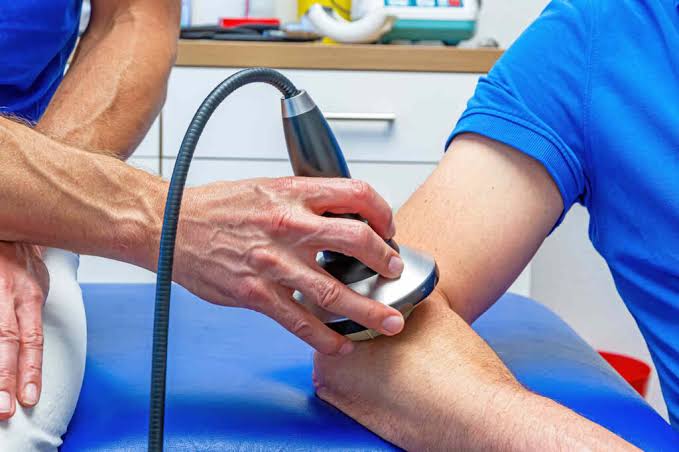
Rest usually helps a strained muscle. It doesn’t always help plantar fasciitis or tennis elbow, two of the more stubborn overuse injuries out there, because both conditions involve tissue that has stopped healing properly on its own rather than tissue that’s simply inflamed. Stretching, orthotics and time off the activity that caused it are the standard first steps, but for a portion of patients, symptoms drag on for months regardless. That’s usually the point where shockwave therapy comes up as an option.
Key Takeaways
- Shockwave therapy uses focused acoustic pressure waves to stimulate blood flow and cellular repair in chronically irritated tendon or fascia tissue.
- It’s typically considered after four to six weeks of conservative treatment, rest, stretching, orthotics, hasn’t resolved symptoms on its own.
- A course of treatment is usually delivered over three to five sessions spaced roughly a week apart, rather than as a single session.
- The practical next step: a proper assessment first, to confirm the diagnosis is actually plantar fasciitis or lateral epicondylitis and not something that mimics either condition.
What Is Shockwave Therapy?
Extracorporeal shockwave therapy, usually shortened to shockwave therapy, delivers focused acoustic pressure waves through the skin to a specific point of chronic tissue irritation. The theory behind it is that controlled microtrauma from the waves triggers the body’s own healing response in tissue that has essentially stalled, rather than continuing to heal on its own the way a fresh sprain would. It’s most commonly used for tendon and fascia conditions that haven’t responded to weeks of more conservative care, rather than as a first-line treatment for a fresh injury or an acute flare-up.
What Does a Session Actually Involve?
A session is generally quick, often 15 to 20 minutes, and doesn’t typically require anesthesia. DC Chiropractic in Markham offers shockwave therapy in Markham as part of its physiotherapy services, delivered alongside the strengthening and stretching work that supports the treatment rather than replacing it. Some soreness at the treatment site for a day or two afterward is common and expected, similar to the ache that follows a deep tissue massage. Most patients are advised to continue whatever home exercise program they’ve been given between sessions, since the treatment tends to work best as part of a broader recovery plan rather than a standalone fix that undoes months of overuse on its own.
How Does It Help Plantar Fasciitis?
Plantar fasciitis is inflammation and, in chronic cases, degeneration of the band of tissue running along the bottom of the foot. The classic complaint is a sharp pain in the heel with the first steps in the morning, which eases somewhat through the day and returns after long periods on the feet. When stretching, night splints and orthotic support haven’t resolved it after several weeks, shockwave therapy targeting the heel and arch is one of the options a physiotherapist might raise, often alongside continued stretching rather than instead of it.
How Does It Help Tennis and Golfer’s Elbow?
Tennis elbow, lateral epicondylitis, and golfer’s elbow, medial epicondylitis, both involve irritation where the forearm tendons attach at the elbow, usually from repetitive gripping or wrist motion rather than an actual tennis or golf injury in most patients. The same logic applies here: rest, activity modification and a graduated strengthening program come first. Shockwave therapy tends to enter the conversation for cases that have dragged on for a couple of months without meaningful improvement, particularly for patients who can’t fully rest the arm because of work.
Who Should Consider It, and Who Shouldn’t?
Shockwave therapy isn’t right for everyone. It’s generally not recommended during pregnancy, for patients on blood thinners or with certain clotting disorders, or directly over major nerves, blood vessels or growth plates in younger patients. A proper assessment before starting treatment is what rules these factors in or out, along with confirming the diagnosis is actually the condition being treated rather than something with similar symptoms, like a nerve entrapment that mimics tennis elbow or a stress fracture that mimics plantar fasciitis. Getting that assessment right matters more than the treatment itself, since shockwave therapy aimed at the wrong diagnosis simply wastes several weeks that could have gone toward the right one.
When Rest Alone Hasn’t Worked
Plantar fasciitis and tennis elbow share a frustrating pattern: both tend to improve slowly with conservative care, and both can drag on long enough that patients start to wonder if they’ll ever fully resolve. Shockwave therapy isn’t a shortcut around the stretching and strengthening work, but for the right patient at the right point in recovery, it can help move a stalled injury forward instead of leaving it to run its own slow course.
DC Chiropractic in Markham treats both conditions as part of its physiotherapy program, working shockwave therapy in alongside the rest of a patient’s recovery plan rather than as an isolated procedure.