
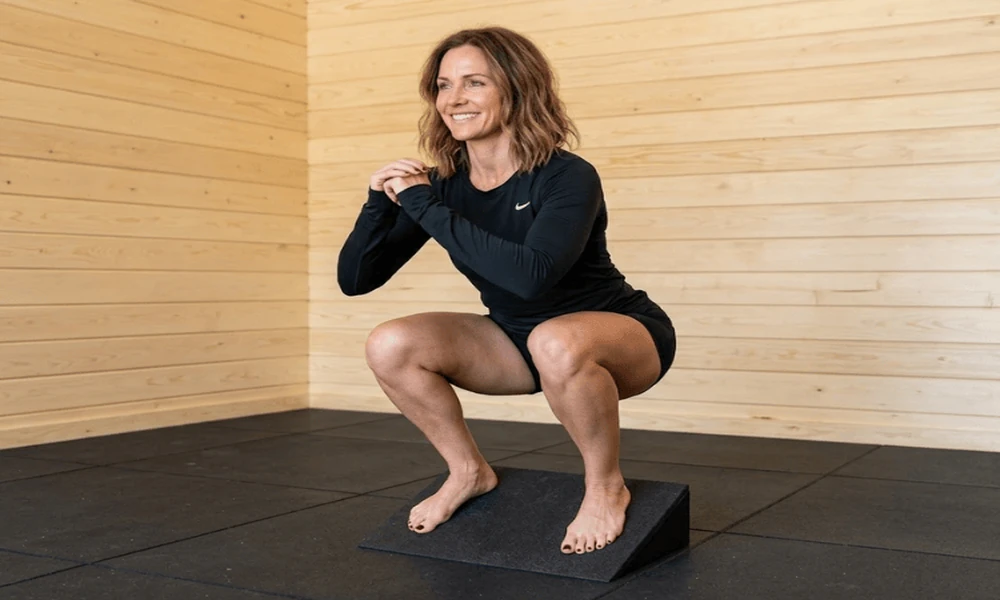
If you struggle to squat deeply without your heels lifting or your back rounding, you’re not alone. Limited ankle movement can make squats feel awkward. A slant board can make the movement more comfortable while you build strength and practise your squat form.
A slant board is an angled platform that raises your heels above your toes. This changes the position of your ankles and can affect how a squat feels.
What a Slant Board Changes
With your heels raised, your ankles don’t need to bend as far for your knees to move forward during a squat. This may help you reach a deeper position while keeping your torso more upright. The position can also place more emphasis on your quadriceps, the muscles at the front of your thighs.
Slant board squats are used by lifters and athletes, and they can be a useful variation for people who want to train their legs through a comfortable range of motion.
Key Benefits
A more comfortable squat position: Raising your heels may help you squat deeper if limited ankle movement makes a flat-footed squat difficult.
A quad-focused exercise: The heel-elevated position allows your knees to move farther forward, which can increase the work done by your quadriceps.
A more upright torso: Some people find it easier to keep their chest lifted and torso upright while squatting on a slant board.
Practice through a useful range of motion: Squatting on the board lets you practise controlled ankle and knee movement. The board itself doesn’t guarantee improved mobility, but it can be one tool in a broader strength and mobility routine.
How to Do a Slant Board Squat
- Place the board on a stable, non-slip floor, with the raised end behind you.
- Stand with your heels on the raised part and the balls of your feet lower down. Keep your feet about hip-width apart.
- Brace your core and keep your chest comfortably lifted.
- Bend your knees and lower your hips slowly, allowing your knees to travel forward in line with your toes.
- Lower only as far as feels comfortable, then press through your feet to stand.
Move slowly, especially during your first few sessions. Control matters more than speed or depth.
Form Tips
- Keep your knees tracking in line with your toes rather than collapsing inward.
- Keep your feet in contact with the board instead of rocking toward your toes.
- Use a range of motion you can control without pain.
- Breathe in as you lower and breathe out as you stand.
- Hold a sturdy support if you need help with balance.
Beginner Progressions
Stage 1: Bodyweight box squat Place a bench or box behind you. Squat until you lightly touch it, then stand. This helps you practise depth and control.
Stage 2: Bodyweight squat Once you’re comfortable with the box squat, try squatting without it. Start with two or three sets of 8 to 12 controlled reps.
Stage 3: Tempo squat Take three seconds to lower, pause briefly, then stand at a steady pace. Use a depth you can maintain with good control.
Stage 4: Goblet squat Hold a light dumbbell or kettlebell close to your chest. Start with a manageable weight and keep your torso steady.
Stage 5: Split squat Place your front foot on the board and step your other foot behind you. This variation works one leg at a time and adds a balance challenge. Use a wall or sturdy support if needed.
You don’t have to progress through every stage. Stay with the version that feels appropriate for your current strength and comfort.
Choosing the Right Board
Slant boards come in different angles, sizes and materials. Adjustable models let you start with a gentler incline and change the angle, while fixed boards have a simpler design. Check the board’s grip surface, stability and weight capacity before buying. If you’re comparing options, this guide to choosing a slant board for squats can help you consider what may suit your goals and training space.
Who Should Be Careful?
A heel-elevated squat may feel different from a regular squat and can place more demand on your knees. If you have a knee condition, a recent injury or ongoing pain, speak with a doctor or physiotherapist before adding it to your routine.
Start with bodyweight only. Stop if you feel sharp pain, or if discomfort continues after your workout.
Slant board squats can be a useful way to practise squatting with your heels raised and strengthen your legs. Begin with a manageable range of motion, focus on controlled reps and progress gradually.