
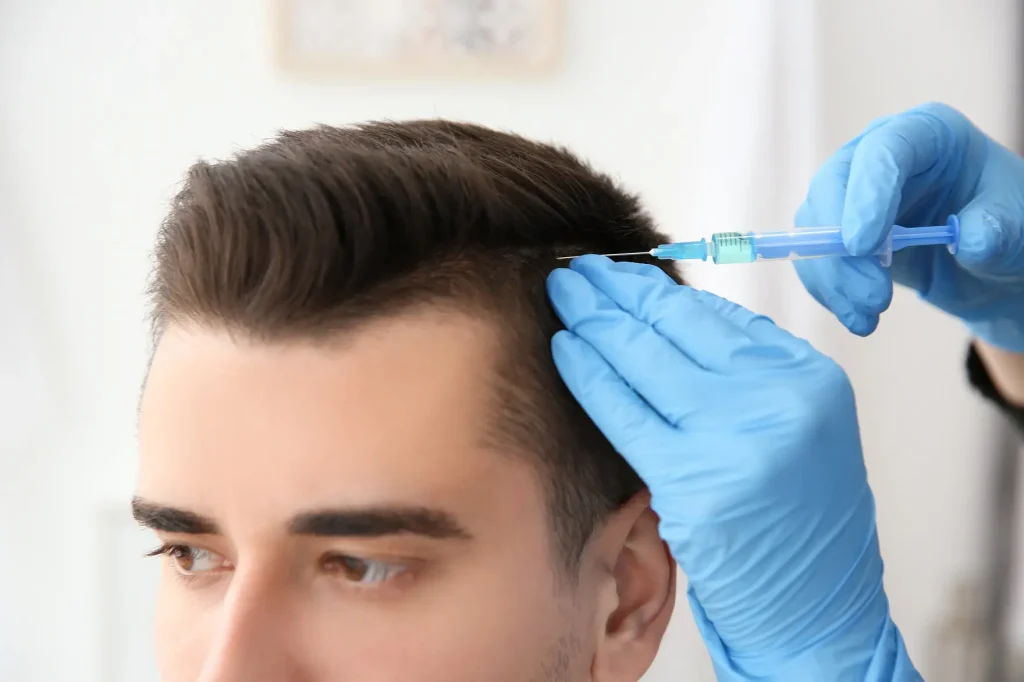
Androgenetic alopecia affects roughly 58% of Indian men between the ages of 30 and 50. That is more than half the adult male population in that age bracket dealing with follicles that are actively shrinking, and most of them are either applying oils that cannot reach the root cause, cycling through supplements without a diagnosis, or simply waiting it out hoping the thinning will stop on its own.
The gap between how many people need a clinical hair regrowth treatment and how many actually walk into the best hair treatments clinic in Delhi remains enormous. What has started closing that gap is GFC therapy for hair loss.
A pilot study published in the International Journal of Research in Dermatology found that 100% of patients treated with growth factor concentrate hair therapy tested negative on the hair pull test within four months, and 80% reported high satisfaction with the outcome.
For a non surgical treatment with no downtime, those numbers explain why GFC is showing up in more conversations than PRP these days.
GFC vs PRP for Hair Loss: Understanding the Difference and Which Works Better
Both GFC and PRP start from the same place: the patient’s own blood. A small sample is drawn, processed in a centrifuge, and the concentrated result is injected into the scalp. On the surface they sound nearly identical, which is exactly where most of the confusion comes from.
- What PRP Extracts: PRP separates blood into layers and collects the platelet rich portion. That portion does contain growth factors, but it also carries white blood cells and residual plasma components along for the ride. Those extra cells can trigger mild inflammation at the injection site, however more importantly, they make the growth factor concentration unpredictable from one session to the next.
- What GFC Extracts GFC starts with the same blood sample but runs a more selective extraction. Instead of collecting the entire platelet rich layer as is, the process specifically activates and isolates the growth factors while leaving the inflammatory cells behind.
- Why the Difference Matters: PRP’s biggest limitation has always been variability. One session might deliver a strong growth factor concentration and the next might not, because the output depends heavily on the centrifuge settings and the kit being used. GFC standardises that concentration at the extraction stage itself, which is why clinics like Evoke Hair Clinic offering both options are increasingly leading with GFC for active hair fall and early stage thinning.
- The Simple Version: PRP is like squeezing an orange and drinking whatever comes out, pulp and seeds included. GFC is like cold pressing that same orange and filtering so only the concentrated, nutrient dense part reaches the glass. Same fruit, more refined delivery, and the follicles respond to that refinement.
What a GFC Treatment Course Looks Like
The process for GFC Treatment is quite easy to follow and most people are rather surprised by how little it disrupts their day. A full session from blood draw to walking out takes under an hour.
Blood Draw: About 16 to 20 ml drawn from the arm, identical to a routine diagnostic test. The sample goes into a specialised GFC kit that separates and activates growth factors over roughly 30 minutes
Injection: A topical numbing cream goes on first, and then the concentrated growth factors are injected across the thinning zones using a fine needle in a grid pattern. Most patients describe it as mild prickling rather than actual pain. The whole process takes 15 to 20 minutes.
After the Session: No recovery window. Patients walk out and carry on with their day. Some mild redness or warmth on the scalp is normal and settles within hours. Hair washing resumes the next morning.
The Full Course: A standard GFC therapy for hair loss protocol involves 3 to 4 sessions spaced a month apart. Reduced shedding usually shows up after the first or second sitting, which matters emotionally even before new growth appears, because watching less hair fall out changes how the whole situation feels. Visible thickness builds between months three and six, and maintenance sessions every 4 to 6 months keep the progress steady.